
Planting Bulbs in the Eye of a Tree (Underplanting for Seasonal Impact)
The “eye” of a tree—the open ground around the base—is often underused or left bare. But it’s one of the best places to naturalise bulbs, especially in spring when trees are still leafless and light reaches the ground.
Done well, this creates a layered display: bulbs flower first, then the tree takes over. Done poorly, and bulbs struggle in shade or dry soil. Timing and selection make all the difference.
Quick Answer
Plant early spring bulbs that flower before the tree fully leafs out, choose varieties suited to partial shade and root competition, and match bulb flowering time with the tree’s seasonal cycle for best results.
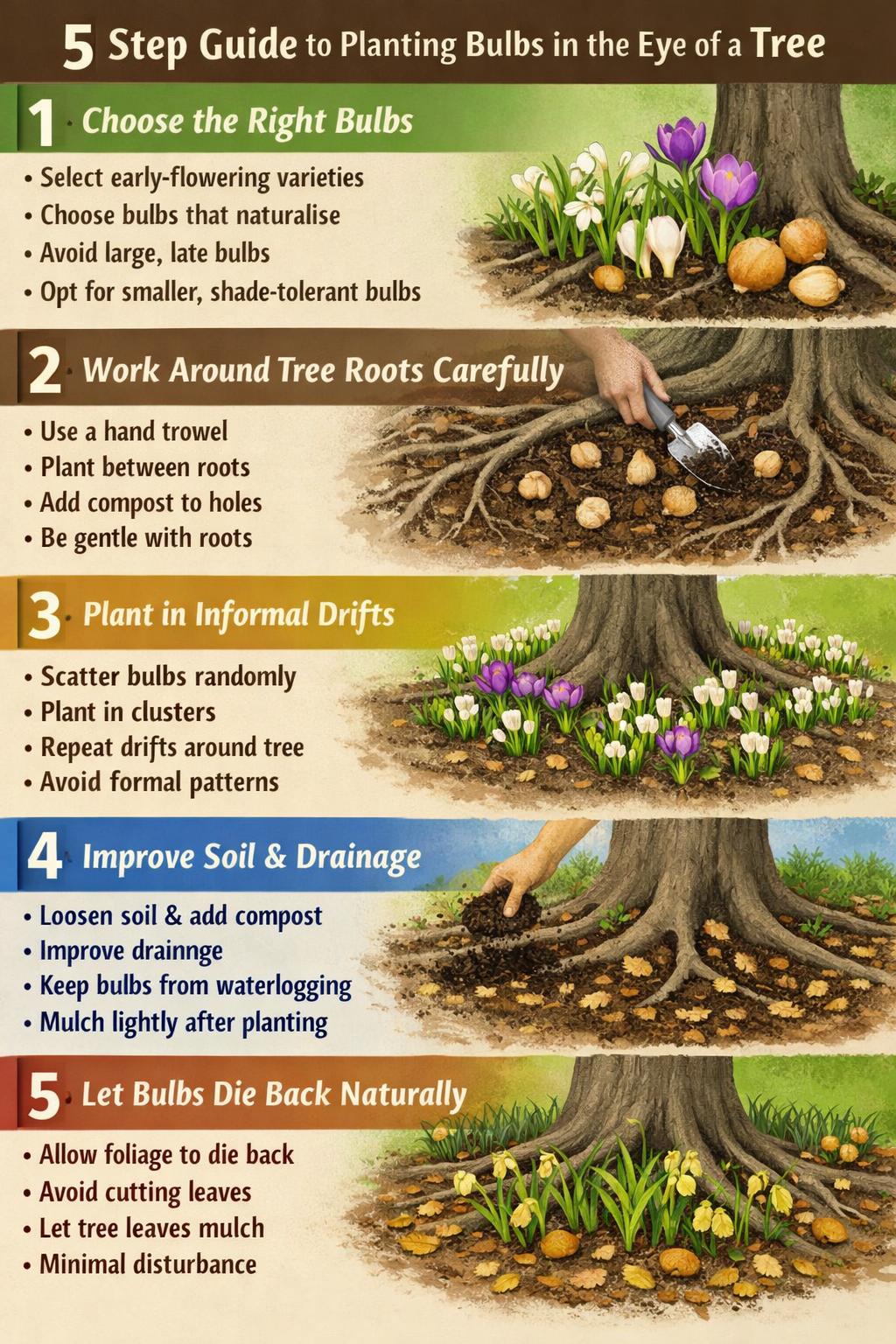
5 Step Guide to Planting Bulbs in the Eye of a Tree
Step 1: Choose the Right Bulbs
Not all bulbs cope with shade and root competition.
- Select early-flowering varieties that bloom before canopy closes
- Choose bulbs known for naturalising (they return and spread)
- Avoid large, late bulbs that need full sun
- Prioritise smaller bulbs that establish easily among roots
Step 2: Work Around Tree Roots Carefully
Tree roots are the main limitation—not shade alone.
- Use a hand trowel instead of digging large holes
- Plant between roots rather than cutting through them
- Add a little compost to each planting hole
- Avoid disturbing the tree’s root system excessively
Step 3: Plant in Informal Drifts
Natural planting works best under trees.
- Scatter bulbs and plant where they fall
- Group in clusters for visual impact
- Repeat drifts around the tree for balance
- Avoid rigid circles or evenly spaced patterns
Step 4: Improve Soil and Drainage
Tree bases can be dry or compacted.
- Loosen topsoil gently before planting
- Add organic matter to improve moisture retention
- Ensure bulbs aren’t sitting in waterlogged pockets
- Mulch lightly after planting
Step 5: Let Bulbs Die Back Naturally
This ensures they return year after year.
- Allow foliage to yellow and collapse fully
- Avoid cutting or tying leaves too early
- Let fallen tree leaves act as natural mulch
- Minimise disturbance during this period
Best Varieties & Why
- Snowdrops (Galanthus) – thrive in partial shade and naturalise easily
- Crocus (species types) – early flowering before canopy closes
- Scilla siberica – excellent for carpets of blue under trees
- Anemone blanda – low-growing and tolerant of light shade
- Narcissus (small varieties) – reliable and resistant to pests
- Fritillaria meleagris – ideal for slightly damp soils
These bulbs are adapted to woodland-style conditions, making them ideal companions for trees.
Common Issues, Pests & Diseases
- Poor flowering – caused by too much shade (late-flowering bulbs especially)
- Dry soil stress – tree roots outcompete bulbs for water
- Disturbed roots – from overly aggressive planting
- Patchy growth – planting too sparsely or in poor soil
The biggest mistake is choosing bulbs that need more sun than the location provides.
Best Fertiliser, Soil, Lighting & Growing Conditions
- Fertiliser: Light application of balanced fertiliser in early spring if needed
- Soil: Loosened, organic-rich, but well-drained
- Light: Full sun in early spring, partial to full shade later
- Water: Moderate—extra watering may be needed in dry spells
- Pruning: Not required for bulbs; manage tree canopy if excessively dense
Understanding soil improvement helps long-term success → click here
Time of Year
- Autumn: Best time to plant spring bulbs under trees
- Late winter to early spring: Flowering window before canopy closes
- Spring onward: Tree leaf cover increases, reducing light
Timing is everything—bulbs must complete most of their growth before shade intensifies.
Plant Characteristics
(Shade-tolerant, early bulbs share these traits:)
- Type: Bulbs, corms, or tubers
- Height: Typically 10–30 cm
- Growth habit: Seasonal, dies back after flowering
- Flowering: Late winter to mid-spring
- Light requirement: Sun early, shade tolerant later
Climate and Regional Notes
- Ireland & UK: Ideal—natural woodland conditions suit bulb planting under trees
- Dry regions: Additional watering may be needed due to root competition
- Dense canopy trees: Choose very early bulbs only
Irish gardens are particularly well-suited to this style—moist soils and mild springs give bulbs a strong start.
Pro Tips
- Plant more bulbs than you think—you need density for impact
- Start near the outer edge of the canopy where light is strongest
- Combine 2–3 bulb types for staggered flowering
- Let bulbs naturalise—avoid replanting every year
- A light leaf mulch mimics natural woodland conditions
Underplanting trees is one of those techniques that quietly improves every year with almost no extra work.
Frequently Asked Questions
Can bulbs really grow under trees?
Yes—especially early spring bulbs that flower before the tree comes into full leaf.
What does “the eye of a tree” mean?
It refers to the open soil area around the base of the tree, within the canopy.
Do bulbs get enough light under trees?
In early spring, yes. That’s when they do most of their growing and flowering.
Will tree roots stop bulbs from growing?
They can compete, but careful planting between roots works well.
Should I water bulbs under trees?
In dry periods, yes—tree roots can take most available moisture.
Can I plant large bulbs like tulips here?
You can, but they’re less reliable. Smaller, woodland-type bulbs perform better.
Do I need to fertilise regularly?
Usually not—an occasional light feed is enough.
Will bulbs spread under trees?
Yes, many naturalising types will gradually multiply.
Can I plant bulbs right up to the trunk?
It’s better to start slightly away from the trunk where roots are less dense.
What’s the biggest mistake with this method?
Choosing bulbs that flower too late—by then, there’s not enough light.
Comprehensive List of Bulbs Suitable for Planting Under Trees
Very Early (Late Winter)
- Snowdrops (Galanthus)
- Winter aconite (Eranthis hyemalis)
Early Spring
- Crocus (species and early hybrids)
- Chionodoxa (glory-of-the-snow)
- Scilla siberica
- Iris reticulata
Mid Spring
- Anemone blanda
- Muscari (grape hyacinth)
- Small narcissus varieties (e.g. ‘Tête-à-Tête’)
- Fritillaria meleagris
Moist/Shaded Conditions
- Fritillaria meleagris
- Leucojum (summer snowflake)
- Anemone nemorosa (wood anemone)
Naturalising Woodland Bulbs
- Bluebells (Hyacinthoides non-scripta)
- Cyclamen (hardy types like Cyclamen hederifolium)
Suitable Trees for Bulb Underplanting
Best Trees (Light Canopy / Late Leafing)
- Apple (Malus)
- Cherry (Prunus)
- Birch (Betula)
- Rowan (Sorbus)
Moderately Suitable
- Maple (Acer, lighter varieties)
- Hawthorn (Crataegus)
More Challenging (Dense Canopy)
- Beech (Fagus)
- Oak (Quercus)
Lighter canopies allow more spring light—this directly improves bulb performance.
Related Guides
Closing Section
Planting bulbs in the eye of a tree is about working with nature’s timing. Bulbs take advantage of early light, then quietly retreat as the tree takes over.
Choose the right varieties, plant gently around roots, and let them settle in. Give it a year or two—and what was once bare ground becomes one of the most quietly impressive parts of the garden.