How to Plant Bulbs in Woodlands (For Natural, Self-Spreading Displays)
Woodland bulb planting is one of the most rewarding long-term garden decisions you can make. Done properly, it creates that classic early spring effect—drifts of colour weaving through trees—without needing constant replanting.
The goal isn’t precision. It’s establishing bulbs that settle in, spread naturally, and improve year after year.
Quick Answer
Plant shade-tolerant, early-flowering bulbs in large, informal drifts within deciduous woodland, improve soil with organic matter, and allow foliage to die back fully so bulbs can naturalise and spread.
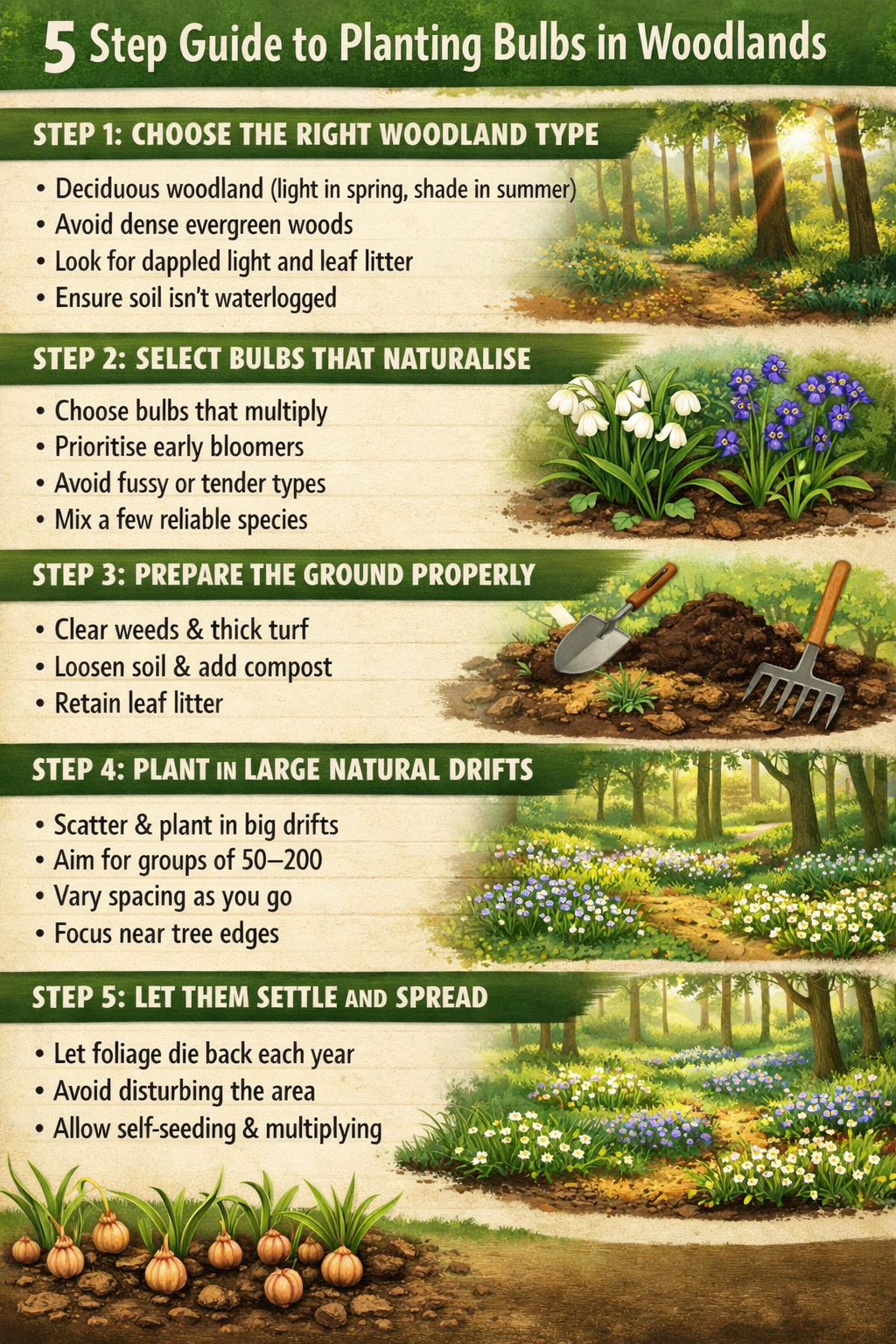
5 Step Guide to Planting Bulbs in Woodlands
Step 1: Choose the Right Woodland Type
Not all woodland conditions suit bulbs equally.
- Deciduous woodland is ideal (light in spring, shade in summer)
- Avoid dense evergreen woods with heavy shade year-round
- Look for areas with dappled light and leaf litter
- Ensure soil isn’t permanently waterlogged
Step 2: Select Bulbs That Naturalise
Woodland planting is about long-term spread, not one-season colour.
- Choose bulbs that multiply and seed themselves
- Prioritise early bloomers that finish before canopy closes
- Avoid high-maintenance or tender bulb types
- Mix a few reliable species rather than too many varieties
Step 3: Prepare the Ground Properly
Minimal disturbance—but smart preparation makes a big difference.
- Clear heavy weeds and thick turf if present
- Lightly loosen the top layer of soil between roots
- Incorporate leaf mould or compost to mimic woodland soil
- Keep existing leaf litter—it helps retain moisture
Step 4: Plant in Large Natural Drifts
Impact comes from scale and randomness.
- Scatter bulbs and plant where they land
- Aim for generous groupings (50–200 bulbs where possible)
- Vary spacing slightly to avoid uniform patterns
- Focus planting around tree edges where light is stronger
Step 5: Let Them Settle and Spread
Resist the urge to over-manage.
- Allow foliage to die back naturally every year
- Avoid digging or disturbing planted areas
- Let bulbs self-seed and multiply over time
- Top up with additional bulbs in year one or two if needed
Best Types of Woods
Ideal Woodland Conditions
- Deciduous trees (oak, birch, beech, ash)
- Seasonal light—bright in spring, shaded in summer
- Moist but well-drained soil
- Natural leaf litter layer
Less Suitable
- Dense evergreen woods (too dark year-round)
- Very dry woodland (bulbs struggle to establish)
- Waterlogged ground (bulbs rot quickly)
If you’re choosing a site, deciduous woodland almost always wins—this mirrors natural bulb habitats.
Best Types of Bulbs for Woodland Planting
- Snowdrops (Galanthus nivalis) – early, reliable, spreads steadily
- Bluebells (Hyacinthoides non-scripta) – iconic woodland carpets
- Crocus (species types) – early colour and pollinator-friendly
- Anemone nemorosa (wood anemone) – low-growing and natural
- Scilla siberica – strong colour and easy spread
- Eranthis hyemalis (winter aconite) – thrives in leaf litter
- Fritillaria meleagris – ideal for damp woodland edges
- Cyclamen hederifolium / coum – excellent under trees
These bulbs are adapted to woodland cycles—grow early, store energy, then disappear.
Common Issues, Pests & Diseases
- Poor establishment – often due to dry or compacted soil
- Weak flowering – caused by too much shade (especially late-flowering bulbs)
- Bulb rot – from waterlogged conditions
- Slow spread – normal in year one; improves over time
Woodland bulbs are generally low-maintenance once established—the early years matter most.
Best Fertiliser, Soil, Lighting & Growing Conditions
- Fertiliser: Usually unnecessary—leaf litter provides nutrients naturally
- Soil: Rich in organic matter, slightly moist, well-drained
- Light: Full light in early spring, partial to full shade later
- Water: Natural rainfall is usually sufficient
- Pruning: Not required—focus on allowing natural dieback
Understanding natural soil structure helps → click here
Time of Year
- Autumn: Best time to plant most woodland bulbs
- Late winter to early spring: Flowering period
- Spring: Foliage develops and stores energy
- Summer: Bulbs go dormant under canopy shade
The entire cycle depends on early-season light—miss that, and performance drops.
Plant Characteristics
(Woodland bulbs typically share these traits:)
- Type: Bulbs, corms, or tubers
- Height: 10–40 cm
- Growth habit: Seasonal, naturalising
- Flowering: Late winter to mid-spring
- Foliage: Must die back naturally for regeneration
Climate and Regional Notes
- Ireland & UK: Ideal—cool, moist conditions mimic natural woodland habitats
- Dry climates: May require watering during establishment
- Cold regions: Bulbs are generally hardy and perform well
Irish woodlands, in particular, are perfectly suited—this style often thrives with very little intervention.
Pro Tips
- Start with fewer species, but plant them in large numbers
- Focus on early-flowering bulbs—they perform best in woodland
- Plant near paths or edges where displays are visible
- Don’t clear all leaves—this is natural mulch and fertiliser
- Expect gradual improvement—year three is often the breakthrough
A well-planted woodland rarely peaks in year one—it builds into something far better.
Frequently Asked Questions
Can I plant bulbs in dense woodland?
Only certain types, and results are usually weaker. Deciduous woodland is far better.
Do I need to dig deeply when planting?
No—work around roots and plant at appropriate depth without major disturbance.
Will bulbs spread on their own?
Yes—many woodland bulbs naturalise through division and self-seeding.
How long does it take to look established?
Typically 2–3 years for a strong, natural effect.
Do I need to water woodland bulbs?
Usually not after establishment, unless conditions are unusually dry.
Can I mix many different bulb types?
You can, but fewer types in larger drifts usually look better.
Should I remove fallen leaves?
No—leaf litter improves soil and protects bulbs.
Why aren’t my bulbs flowering well?
Often due to too much shade or poor soil conditions.
Are woodland bulbs low maintenance?
Very—once established, they require minimal care.
Can I plant bulbs under any tree?
Most deciduous trees are suitable, but dense canopies reduce performance.
What Bulbs Spread Best and Give the Most Impact
If your goal is coverage and long-term effect, focus on these:
- Bluebells (Hyacinthoides non-scripta) – unmatched for large-scale carpets
- Snowdrops (Galanthus) – steady spread and early presence
- Scilla siberica – strong colour and quick naturalising
- Anemone nemorosa – forms dense, low mats over time
- Eranthis hyemalis – spreads well in suitable conditions
These are the backbone of classic woodland planting—reliable, spreading, and visually powerful when planted at scale.
Related Guides
Closing Section
Woodland bulb planting rewards patience more than effort. Choose the right setting, plant generously, and then step back.
Give it a couple of seasons, and what starts as scattered planting turns into something that feels completely natural—like it was always part of the landscape.